
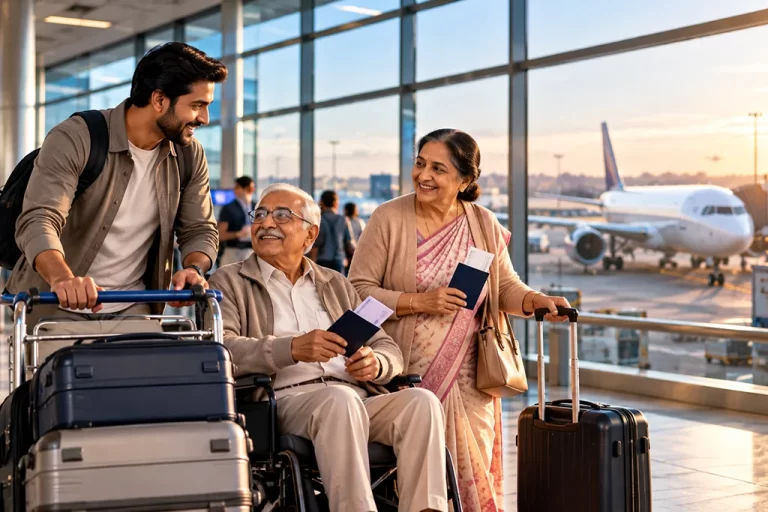
Booking a flight for your parents feels different from booking one for yourself. You’ve done it a hundred times for you, pick the cheapest reasonable option, grab an aisle seat, done. But when it’s your mother, who gets confused in busy airports, or your father, who’s still recovering from a knee surgery, suddenly every detail matters. The layover. The seat. Whether someone will actually help them if they need it.
That worry is exactly why so many Canadian families end up searching for guidance on flying with elderly parents from Canada to India. Not because they don’t know how to book a flight, but because they want to get this one right.
Here’s what we tell families when they call us.
Forget age. Think about what they actually need.
The first thing worth knowing is that age isn’t really the deciding factor here. We’ve had families ask about very fit 78-year-olds who barely need help, and others asking about a 65-year-old recovering from surgery who needs a lot more support. What matters is mobility, medication, memory, and confidence in unfamiliar places.
So before you book anything, have an honest conversation. Can they walk a long distance through an airport on their own? Do they get anxious or disoriented somewhere new? Do they need help with luggage, or with remembering medication times across a big time change? None of this is medical advice, that conversation belongs with their doctor, especially if there’s anything going on with their heart, lungs, mobility, or a recent surgery. But it’s the conversation that shapes everything else in this guide.
Direct vs Connecting Flights from Canada to India for Elderly Parents
This is usually the first real decision families get stuck on, and there’s no universally right answer.
A direct flight means one takeoff, one landing, no risk of a missed connection. If your parent gets confused in unfamiliar airports, needs medication on a fixed schedule, or simply finds transfers exhausting, paying a bit more for a direct route is often worth it.
But a one-stop flight isn’t automatically the worse option. If the connection is booked on a single ticket, the layover is comfortably long, the connecting airport is manageable and good assistance is available, it can actually be more comfortable, especially if it lands your parents at a better time of day in India.
When can a one-stop flight be a good choice?
A one-stop itinerary can be suitable if:
- It is booked on a single ticket.
- The connection is comfortably long rather than rushed.
- Airport assistance is available if required.
- There is no difficult terminal transfer.
- The connection airport is manageable for the traveller.
- The arrival time works well for the family.
- The itinerary does not require a self-transfer.
What we’d steer you away from is the cheapest itinerary built from two separate tickets on two different airlines. If the first flight is delayed, nobody is automatically responsible for getting your parents onto the second one. That’s the kind of risk that isn’t worth the savings.
The goal isn’t simply to find a nonstop flight. It’s to find an itinerary that matches your parents’ actual needs.
Wheelchair Assistance and Special Travel Requirements for Elderly Parents
Wheelchair assistance sounds like one simple request, but it isn’t. It can mean help from check-in to the gate, help boarding the aircraft, help getting to the actual seat, or help during a connection, and these aren’t automatically bundled together. When you book it, be specific about which parts of the journey your parents will need help with, not just “wheelchair required.” Air India, for instance, asks that this be requested at booking and recommends doing it at least 48 hours ahead, and notes that some passengers may need a medical form (called a MEDIF) processed in advance, which can take a little longer from Canada.
On the medical side, if there’s anything even slightly complicated, recent surgery, oxygen needs, a heart condition, start the conversation with their doctor weeks before departure, not days. The Government of Canada actually recommends around six weeks for older travellers, which sounds early until you realise it takes time to get letters written, forms processed, and prescriptions organised.
Speaking of prescriptions: everything essential goes in the carry-on, in its original labelled container, with a copy of the prescription and both the generic and brand name written down somewhere. It genuinely doesn’t matter that a medicine is legal in Canada; that says nothing about whether it’s fine to carry into India or through a stopover country, so it’s worth double-checking rather than assuming.
Choosing the Best Flight and Layover for Elderly Parents
Once they’re actually on the plane, the small things make the biggest difference. An aisle seat can mean less walking and easier bathroom access. Keep them hydrated, encourage a bit of gentle movement now and then, and stick to the medication schedule you worked out with their doctor rather than improvising mid-flight. If they need something, use the call button, there’s no reason for your father to be wandering a moving aircraft looking for a flight attendant.
If there’s a layover, the golden rule is simple: a longer, calmer connection is generally preferable to a shorter, tighter one. Confirm that assistance has been requested for the connection specifically, not just the first leg. This is one of the most common things that quietly falls through the cracks.
And if there’s a terminal change involved, that’s exactly the kind of detail worth asking about before you book, not after you land at the connecting airport and realise it’s a fifteen-minute walk.
Which Seats Are Best for Elderly Parents?
An aisle seat can make a long flight easier for elderly travellers, particularly if they need regular bathroom access or want to get up and move around. If parents are travelling with a companion, keeping them close together can also make the journey more comfortable.
Extra-legroom seats may be useful for some travellers, particularly on a long-haul flight, but check the additional cost and any eligibility requirements before selecting them.
Exit-row seats can have specific safety and eligibility restrictions, so they may not be suitable for every elderly passenger.
Front-row or bulkhead seats are not automatically the best choice either. Aircraft layouts vary, and some seats may have different armrests, storage arrangements or restrictions. Check the actual seat layout and availability before paying for a particular seat.
What Makes a Good Connection for Elderly Parents?
The best connection isn’t necessarily the airport with the shortest advertised layover. For elderly travellers, the overall airport experience matters just as much.
Before booking, consider:
- Whether the airport layout is manageable.
- Whether there is enough connection time without rushing.
- Whether wheelchair or mobility assistance is available.
- Whether there is a terminal change.
- Whether a self-transfer is required.
- Whether assistance has been requested for each relevant flight segment.
- Whether baggage will be checked through where applicable.
- Whether the arrival time in India works comfortably for the family.
A connection that looks cheaper or faster on a booking screen isn’t necessarily the easiest option for an elderly traveller. The right itinerary is the one that gives them enough time and support to move through the journey comfortably.
What to Do After Elderly Parents Arrive in India
The trip isn’t over the moment the wheels touch down. Confirm who’s collecting your parents, and make sure that person has the flight number and arrival terminal, not just a vague pickup time. Where you can, avoid piling a long road journey straight on top of a long-haul flight, a night’s rest before travelling onward makes a real difference, especially with the climate shift most people feel arriving in India from Canada.
Don't skip the insurance conversation
It’s tempting to tick this box quickly and move on, but it’s worth five extra minutes. A lot of standard travel insurance treats pre-existing conditions as excluded territory, and for elderly travellers, that often means checking carefully what’s covered around hospitalisation, medical evacuation, and any age-related limits before you buy. The cheapest policy on the page isn’t always the one that will actually pay out if something happens in India. It’s a five-minute phone call that can save an enormous amount of stress later.
If they're travelling without you
A lot of families ask us this directly: can my parents make this trip alone? Often, yes, with the right setup.
Keep the itinerary simple, ideally on a single ticket rather than a patchwork of separate bookings. A single-ticket itinerary can involve more than one airline, but it keeps the journey more integrated than separate tickets.
Request meet-and-assist support for the whole journey, not just the departure. Give them a large-print itinerary, label their bag clearly, and make sure emergency contacts are saved in their phone and written on a card in their pocket, not buried in an email somewhere.
And confirm, properly, who’s meeting them in India, not just “someone will be there.”
Elderly Parents Flying from Canada to India: Booking Checklist
Before Booking
- Check mobility needs
- Compare direct and one-stop options
- Check layover duration
- Confirm whether the itinerary is on a single ticket
- Check whether a terminal change is required
- Confirm that no self-transfer is involved
- Check baggage and fare conditions
- Consider the arrival time in India
Before Departure
- Pack medication
- Carry prescriptions
- Keep passport accessible
- Print itinerary
- Save emergency contacts
- Confirm airport assistance
- Confirm connection assistance
- Check baggage allowance
- Confirm pickup in India
At the Airport
- Confirm gate
- Confirm wheelchair or mobility assistance
- Keep family contact details accessible
- Ask airport staff for help if anything changes
Where Mann Travel comes in
This is a lot to think through on top of work, family, and everything else going on. That’s really what we’re here for.
A Mann Travel specialist can help you compare direct and one-stop options with your parents’ actual needs in mind, not just the lowest fare on screen. We can help you compare connection times, request the appropriate mobility assistance, and check baggage and fare conditions before payment.
We’ll also help you understand the itinerary before you commit to it and stay reachable if something changes after you’ve booked — a delayed flight, a rescheduled connection or an extended stay.
If you’re planning this trip for your parents, talk to us before you book. We’ll walk through the route, the assistance, the connection and the backup plan together, so the only thing you’re really thinking about is seeing them off, and seeing them land safely.
Frequently Asked Questions
Is a direct flight better for elderly parents travelling to India?
A direct flight usually reduces the stress of changing aircraft, navigating another airport and transferring luggage. However, a one-stop flight may be suitable if it offers a more convenient departure time, a comfortable connection, good airport assistance and a single-ticket itinerary.
How do I arrange wheelchair assistance for an elderly passenger?
Request wheelchair or mobility assistance while booking the flight, and specify how much support your parent needs. Assistance may cover travel from check-in to the gate, boarding, aircraft seating, connections or baggage collection. Airline policies vary, so confirm exactly what assistance is included for each part of the journey.
How early should I request airport assistance?
Request assistance as early as possible, preferably when the ticket is booked. Some airlines recommend submitting requests at least 48 hours before departure, particularly where medical forms or special arrangements are involved. Always reconfirm the request before travel.
Can elderly parents travel alone from Canada to India?
Yes, but the itinerary should be as simple as possible. Choose a direct flight or a single-ticket itinerary, request airport assistance, prepare printed instructions and arrange for a named family member to meet them in India. Avoid self-transfers and separate tickets because they can make delays and missed connections more difficult to manage.
Can elderly parents carry prescription medicines from Canada to India?
They should carry essential medication in their cabin baggage, in the original labelled packaging, together with prescriptions and a doctor’s letter where appropriate. Travellers are responsible for checking whether their medicines are permitted in India and any transit country. Canadian approval does not automatically guarantee permission abroad.
Where should elderly passengers sit on a long-haul flight?
An aisle seat can make it easier to access the bathroom, move around and request help from the cabin crew. Extra-legroom seating may improve comfort, but it can have eligibility restrictions and may cost more. Exit-row seats may also have restrictions. Families should check the aircraft layout and keep accompanying passengers together where possible.
Which connection is best for elderly parents travelling to India?
There isn’t one universally best connection airport. Look for a manageable airport layout, adequate connection time, available assistance, no self-transfer, minimal terminal changes and baggage handling that is straightforward for the itinerary. The arrival time in India should also work comfortably for the traveller and family.
What should elderly parents carry in their hand luggage?
Essential medication, prescriptions, travel documents, valuables, emergency contact details and anything they may need during the flight should be kept in hand luggage. Essential medicines and important documents should not be placed in checked baggage.
How long should an elderly traveller's layover be?
There isn’t one universally ideal layover. A comfortable connection should allow enough time for disembarkation, airport assistance, security or immigration where required, and movement between gates without rushing. The appropriate connection time depends on the airport, itinerary and traveller’s mobility.
Should elderly parents have wheelchair assistance if they can walk?
Wheelchair or mobility assistance can still be useful if an elderly traveller may struggle with long airport distances, standing for extended periods or navigating a large airport. The level of assistance requested should match the traveller’s actual needs.
How can Mann Travel help with flights for elderly parents?
Mann Travel can help families compare practical Canada-to-India flight options, assess direct and connecting itineraries, compare connection times, request suitable airport assistance, and review baggage and fare conditions before payment. The team can also help families understand the arrangements before booking, which is particularly valuable when a parent is travelling alone or has limited mobility.