
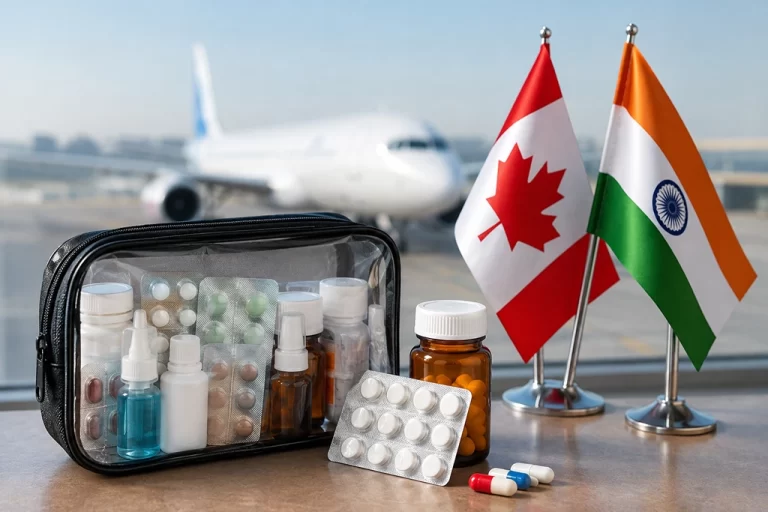
Most of what you’ve read online about carrying medicines to India is either outdated, overly cautious, or wrong. Customs won’t seize your blood pressure pills. They will confiscate undocumented controlled substances. Knowing the difference is the entire point of this article.
Here’s what actually determines whether medicines allowed from Canada to India clear customs without a second look: original packaging, a prescription that matches the drug in your hand, and a quantity that doesn’t look like you’re stocking a pharmacy. Meet those three conditions and your everyday prescriptions; blood pressure, diabetes, thyroid, allergy medication, are non-event at the airport.
The key is knowing the basic rules around packaging, documentation, and quantity so that travelling with medication feels like a non-issue rather than a source of airport anxiety.
This guide breaks down exactly what’s allowed, what needs extra paperwork, what’s outright restricted, and how to build a simple document folder that takes the guesswork out of the process.
The Basic Rule: Personal Use + Original Packs + Prescription
India generally allows travellers to bring personal-use prescription medicines in their baggage, provided a few conditions are met:
- The medication is in its original packaging, showing your name, the drug name, and dosage.
- You’re carrying a copy of your prescription, and ideally a short doctor’s letter confirming what you’re taking and why.
- The quantity is reasonable for personal use during your trip; commonly cited as up to around a 3-month supply, or roughly 100 doses per drug, though this can vary and should be confirmed against current guidance before you travel.
Most everyday medications; blood pressure pills, diabetes medication, thyroid hormone replacement, allergy medication, and similar long-term prescriptions; fall comfortably within these customs rules India applies to incoming travellers. As long as your meds are labelled, documented, and in sensible quantities, this part of the trip is usually smooth.
Red-Flag Meds: Controlled & NDPS Drugs You Must Check
Not every prescription is treated equally. India regulates certain drugs under the Narcotic Drugs and Psychotropic Substances (NDPS) Act, 1985, enforced by the Narcotics Control Bureau (NCB). In simple terms, some painkillers, sleep aids, anxiety medications, and select psychiatric or ADHD medications fall into a stricter category.
Medications that commonly require extra caution include (generic names):
- Codeine and tramadol (above certain quantity limits)
- Morphine and oxycodone
- Diazepam (Valium) and alprazolam (Xanax)
- Zolpidem and methadone
- Certain ADHD stimulant medications
Carrying these prescription medicines India treats as controlled substances, without prior clearance, can lead to seizure at the airport, fines, or more serious legal trouble under the NDPS Act. If any of your medications fall into this category:
- Check whether your specific medication is listed as controlled.
- If it is, apply for import permission from the NCB before you travel, and carry the official permission letter alongside your prescription.
- Declare the medication at the Red Channel on arrival in India, rather than walking through Green Channel.
Canada's Side: What You Must Declare Before You Fly
Rules don’t only apply on landing; Health Canada and the Government of Canada’s Travel.gc.ca guidance set expectations on the way out too. Medications containing controlled substances generally need to stay in their original packaging, be accompanied by a valid prescription, and stay within set limits (commonly a 30–90-day supply depending on the substance).
- Keep all medications in your carry-on bag, not checked luggage.
- Carry a written list of all medications, including generic names.
- Bring your prescription and a doctor’s note, particularly for controlled substances or injectables.
Thinking of it as “what Canada expects when you leave” alongside “what India expects when you arrive” makes the whole process easier to plan around; the same document folder covers both ends of the trip.
Quick Comparison: Canada (Departure) vs. India (Arrival)
| Leaving Canada | Arriving in India |
Packaging | Original packaging required | Original packaging required, with your name/dosage visible |
Documentation | Prescription + doctor’s note recommended | Prescription copy + doctor’s letter recommended |
Quantity guidance | Commonly 30–90 days depending on substance | Commonly ~3 months / ~100 doses per drug (verify current limits) |
Controlled substances | Must be declared, kept in carry-on | Must go through Red Channel with NCB permission if required |
Liquids/injectables | Exempt from standard liquid limits, but declare at screening | Allowed in carry-on with prescription/doctor’s letter |
Cannabis/CBD/THC | Restricted under Canadian export rules for international travel | Banned outright under the NDPS Act, regardless of Canadian legality |
(Rules change periodically on both sides; always confirm current limits with Travel.gc.ca, Health Canada, and India’s Central Drugs Standard Control Organisation (CDSCO) before you fly.)
Document Checklist: What to Keep in Your Handbag
A simple “medication folder” in your carry-on solves most problems before they start:
- All essential medications in their original pharmacy packaging with labels intact
- Printed prescriptions, listing both brand and generic drug names
- A short doctor’s letter on letterhead noting your general condition, medications, dosages, and why you need them
- A simple medication list (name, dose, frequency, condition) you can hand over quickly if asked
- Photos of your prescriptions and doctor’s letter saved on your phone as a backup
- For injectables or liquids (insulin, GLP-1 medications like Ozempic, biologics): keep them in your cabin bag; they’re exempt from the standard 100ml liquid rule, but should still be declared at security
- For controlled/NDPS medications: add your NCB permission letter alongside your passport and visa documents
Common Mistakes That Cause Problems
A few small oversights account for most of the airport headaches travellers run into:
- Carrying loose pills with no labels or prescriptions
- Bringing unusually large quantities of the same medication without an explanation
- Travelling with controlled/NDPS medications without NCB permission
- Assuming CBD or cannabis products are allowed because they’re legal in Canada
- Packing all medications in checked baggage instead of carry-on
- Skipping the doctor’s letter for complex or controlled medication regimens
The fix is simple: keep everything in original packaging, and build one small “medication folder” that lives in your carry-on for the whole trip.
How Mann Travel Helps Canadian Families Navigate This
Between doctor’s appointments, packing, and coordinating with family back home, medication logistics can feel like one more thing on an already long list. This is where having a real travel partner, rather than a self-serve booking site; makes a genuine difference.
Mann Travel helps by:
- Choosing flights and routes that make managing medication easier, with fewer or shorter layovers where possible
- Pointing travellers toward the right official resources, CDSCO, the NCB, Health Canada, and Travel.gc.ca, rather than guesswork
- Assisting with flight changes if a health situation or length of stay shifts unexpectedly
We’ve helped families across Toronto, Vancouver, and Calgary plan trips for elders and travellers managing complex medication needs; whether that’s carrying medicines from Toronto to India, from Vancouver to India, or from Calgary to India. You focus on your health and your paperwork; we’ll handle the flight piece.
If you’re unsure about travelling with your medications, talk to a Mann Travel specialist before you book, a quick conversation can save a stressful moment at the airport later.
Frequently Asked Questions
How much medicine can I bring from Canada to India?
For personal use, quantities up to roughly a 3-month supply, or around 100 doses per drug, are commonly accepted. Anything beyond that may require special permission, so check current limits before travelling with unusually large quantities.
Do I need a doctor's letter to carry medicines to India?
It’s not always mandatory for basic, small-quantity prescriptions, but it’s strongly recommended, especially for controlled medications, injectables, larger quantities, or complex medication regimens.
Can I carry liquid medicine in cabin baggage to India?
Yes. Prescription liquid or injectable medications are exempt from the standard 100ml carry-on liquid rule, but you should declare them at security screening and carry supporting documentation.
Is CBD oil or cannabis medicine allowed from Canada to India?
No. Cannabis, THC, and CBD oil products are prohibited in India under the NDPS Act, even if they’re legally purchased or prescribed in Canada.
Do I need to declare medicines at Indian customs?
Standard personal medications in reasonable quantities generally don’t require declaration and can go through the Green Channel. Controlled/NDPS medications, unusually large quantities, or anything requiring a special permit should go through the Red Channel with a declaration.
What medicines are banned or restricted in India for travellers?
NDPS-controlled substances (certain painkillers, sedatives, sleep aids, and some ADHD medications) are restricted without prior permission, and all cannabis or CBD products are banned outright, regardless of their legal status in Canada.
Can I carry insulin and injectable medicines on flights to India?
Yes. Insulin and similar injectables are allowed in carry-on baggage, provided you have your prescription or doctor’s letter on hand, they’re specifically exempted from standard liquid restrictions.