
Best overall: compare flexible departure and return dates before booking Vancouver to New Delhi flights. Best for fixed family events: begin comparing once your dates are confirmed; best for urgent travel: choose a ticketable itinerary after checking documents, connections and fare rules.
In-short:
- For Vancouver to New Delhi flights, compare complete return journeys rather than chasing a universal booking day.
- Mann Travel Canada, based in Surrey, BC, helps travellers across Canada compare flights; call (604) 265 9000.
- Fixed family events call for earlier planning; flexible trips allow comparisons across departure and return dates.
- Before booking, check baggage, change conditions, connections and the final journey beyond Delhi.
Why timing matters for your Delhi trip
The best time to book is not a particular weekday or a guaranteed number of weeks before departure. Book when an itinerary meets your dates, journey requirements and acceptable total cost—not because a calendar rule says to buy.
For your 2026 trip, Mann Travel Canada, based in Surrey, BC, serves travellers across Canada with personal help comparing flights and connections. New flight-booking enquiries go to (604) 265 9000.
If you are visiting relatives in Punjab, decide whether Delhi is your final destination or a gateway to Amritsar before comparing tickets. A Delhi arrival followed by another flight or road journey needs a different plan from a trip ending in New Delhi.
What makes the best booking approach
Use these criteria to decide whether to book or keep comparing:
- Date certainty: Separate fixed commitments from dates you can move.
- Complete journey: Compare both directions, including travel beyond Delhi.
- Connection practicality: Check airports, terminals, overnight stops and ticket arrangements.
- Fare conditions: Read baggage, seat-selection, cancellation and change terms before payment.
- Family requirements: Include seating, meals and assistance requests in your comparison.
- Decision readiness: Have passenger names, travel documents and family agreement ready before requesting ticketing.
A useful 2026 comparison keeps these requirements consistent across quotes. A different baggage allowance or return condition is a different offer, even when the flights look similar.
Booking approaches at a glance
| Rank | Booking approach | Best for | Standout feature | Key limitation |
|---|---|---|---|---|
| 1 | Flexible-date comparison | Travellers whose departure and return can move | Tests several complete journeys against the same requirements | Does not suit a fixed arrival deadline |
| 2 | Fixed-event early planning | Weddings, family occasions and school commitments | Starts with the date you must reach your destination | Limits the dates you can compare |
| 3 | Return-flexibility review | Longer visits with an uncertain return | Makes return-date conditions part of the booking decision | Flexible conditions do not remove every change restriction |
| 4 | Ready-to-ticket comparison | Urgent travel | Prioritizes a workable journey and immediate checks | Leaves less time to explore alternatives |
These are booking strategies, not predictions about which airline will offer the lowest fare. Compare the flight itinerary separately; the Vancouver to Delhi direct-versus-one-stop guide covers that decision.
1. Flexible-date comparison: best for movable travel dates
Flexible-date comparison means checking different departure and return combinations before choosing your ticket. Start with dates your household can actually use, including leave, school commitments and pickup arrangements.
As a practical exercise, compare 3 departure dates and 3 return dates. That creates 9 date combinations to review; it is a comparison method, not a promise of savings.
Flexible-date comparison pros:
- Separates a genuine date choice from an unsuitable itinerary.
- Lets you compare the complete return journey.
- Makes trade-offs between travel dates and connection arrangements visible.
Flexible-date comparison cons:
- Requires flexibility at both ends to explore the full range.
- Becomes misleading if baggage or fare conditions change between quotes.
Best for: Families who can move their visit without missing an important event.
For a 2026 trip, write down your acceptable dates before asking for options. A clear range gives the comparison boundaries; an open-ended request for the “best time” does not.
Verdict: Buy when a complete itinerary fits your date range, family requirements and spending limit.
2. Fixed-event early planning: best for family occasions
Fixed-event planning starts with the date you must be in Delhi or Punjab, then works backwards through arrival and onward travel. Begin comparing once that commitment is confirmed rather than waiting for a supposedly ideal booking weekday.
If you are attending a wedding in Punjab, landing in Delhi is not the end of your journey. Account for the onward flight or road transfer before deciding which departure date works.
Fixed-event early planning pros:
- Keeps the family event ahead of a tempting but unsuitable departure date.
- Gives you time to check documents and coordinate relatives.
- Brings onward travel and pickup arrangements into the initial decision.
Fixed-event early planning cons:
- A fixed arrival deadline narrows your choices.
- Booking before leave or family plans are confirmed creates change exposure.
Best for: Travellers with weddings, ceremonies, school dates or other non-movable commitments.
For your 2026 booking, distinguish the event date from the latest acceptable arrival at your final destination. Those are separate dates, especially when Delhi is a transit point.
Verdict: Buy after confirming the event, leave and onward journey; skip waiting solely for a particular weekday.
3. Return-flexibility review: best for longer family visits
Return-flexibility review focuses on what happens if your stay changes. Read the conditions attached to the exact fare rather than treating the word “flexible” as a complete explanation.
Ask about change fees, any fare difference, cancellation conditions and restrictions on the return journey. Your outbound flight can be suitable while the return conditions are not.
Return-flexibility review pros:
- Makes uncertainty about the return date explicit.
- Encourages you to compare conditions alongside the itinerary.
- Helps you choose between a fixed return and a fare with different change terms.
Return-flexibility review cons:
- Permission to change does not guarantee your preferred replacement flight.
- A change can involve a fare difference under the ticket conditions.
Best for: Travellers visiting relatives for an extended stay without a settled return date.
Mann Travel Canada helps travellers across Canada compare flight options and connections. For Vancouver to New Delhi flights, explain your return-date uncertainty at the start of the enquiry, not after choosing a fare.
Verdict: Hold until you understand the return conditions; buy only after accepting the change terms.
4. Ready-to-ticket comparison: best for urgent departures
Ready-to-ticket comparison puts essential checks ahead of a broad search. Confirm who is travelling, their documents, the required arrival date and the journey they can manage before requesting options.
Urgency does not make an unsuitable connection practical. Check transit requirements, airport changes and separate-ticket arrangements before authorizing payment.
Ready-to-ticket comparison pros:
- Concentrates the enquiry on journeys you can use.
- Reduces repeated searches caused by incomplete passenger details.
- Keeps document and connection checks in the decision.
Ready-to-ticket comparison cons:
- Leaves less time to compare date alternatives.
- Pressure to depart can distract from return conditions and baggage rules.
Best for: Travellers who need to leave promptly and have confirmed travel requirements.
Keep existing-booking problems separate from a new flight enquiry. If a ticket already exists, explain that first so the conversation addresses the booking you hold.
Verdict: Buy after the essential checks are complete; skip an itinerary that depends on unresolved entry or transit requirements.
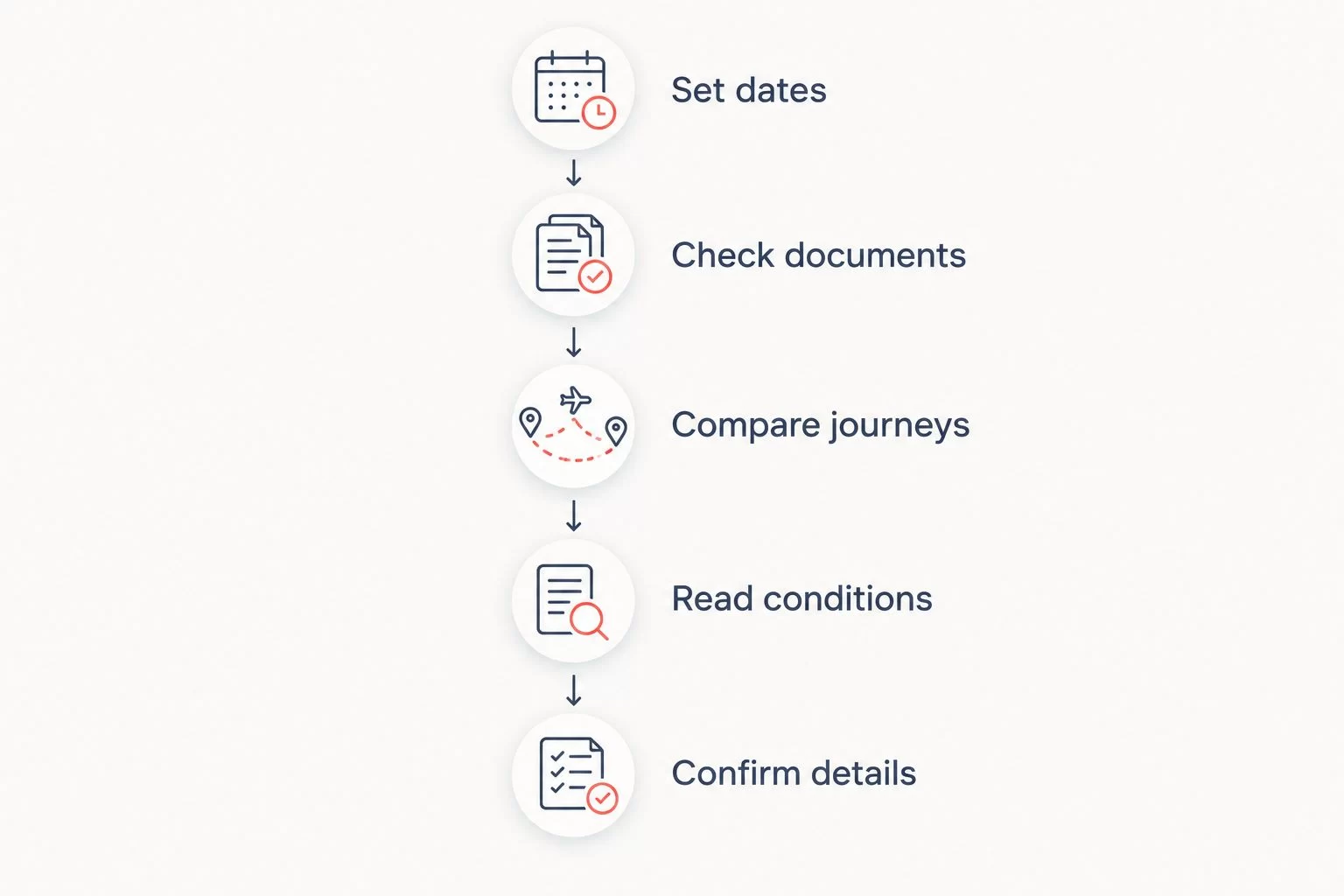
A booking checklist you can use in 2026
Follow this sequence before authorizing a new booking. Keep the same passenger details and requirements throughout so each comparison answers the same question.
- Set dates: Record your preferred dates, acceptable alternatives and final arrival deadline.
- Check documents: Review passport, Indian entry and transit requirements for each traveller and proposed route.
- Compare journeys: Review both directions, airports, connections and travel beyond Delhi.
- Read conditions: Confirm baggage, seating, changes, cancellations and ticket arrangements.
- Confirm details: Check passenger names against travel documents and review the itinerary before payment.
If you are comparing a Delhi arrival with an onward journey to Amritsar, request the ticket arrangement in writing. Ask where baggage must be collected and what applies if a delay affects the next flight; do not assume separate tickets provide the same arrangements as a through booking.
Should you wait for a sale or a particular weekday?
Do not make a weekday rule your booking strategy. Your decision needs a suitable itinerary and acceptable conditions, not a claim that every Vancouver–Delhi ticket becomes better on the same day.
Set a decision point instead. Once an option meets your fixed requirements, review its complete terms and decide whether it fits your budget. If it does not, identify what you can change: dates, routing, trip length or other requirements.
For 2026 travel, avoid comparing a previous quote with a new one from memory. Keep the departure and return dates, flight details, passenger count, baggage and conditions together so you can identify what changed.
Waiting is a decision too. Keep comparing only when you have a clear reason, such as unresolved leave dates or an itinerary that does not meet your needs.
How the booking approaches are ranked
Flexible-date comparison ranks first because it tests alternatives without changing your core travel requirements. Fixed-event planning comes next for travellers whose arrival deadline matters more than date choice.
Return-flexibility review addresses uncertainty during a longer stay. Ready-to-ticket comparison serves urgent departures, where completing essential checks takes priority over an extended search.
The ranking follows date certainty, complete-journey suitability, fare conditions and family requirements. It does not claim a measured cheapest booking window or an airline performance ranking.
Which approach should you choose?
Choose flexible-date comparison unless a fixed event, uncertain return or urgent departure changes your priorities. Start with workable dates, then compare the whole journey under consistent conditions.
Mann Travel Canada is best for travellers across Canada seeking personal help comparing Canada–India flights and connections. For a new Vancouver–Delhi booking enquiry, call the Surrey, BC team at (604) 265 9000 with your dates and family requirements ready.
Frequently asked questions
When is the best time to book Vancouver to New Delhi flights?
Book when a complete itinerary meets your confirmed dates, travel requirements and acceptable total cost. Compare flexible departure and return dates where possible, and check baggage, connections and change conditions before payment.
How many months ahead should I book Vancouver to Delhi?
There is no single advance-booking window that guarantees the best result for every Vancouver–Delhi journey. Begin comparing once your travel requirements are clear, especially when you must reach a family event on a fixed date.
Is Tuesday the best day to book a Delhi flight?
Do not base your purchase on Tuesday alone. Compare the actual journey and fare conditions against your requirements rather than assuming a booking weekday determines the best choice.
Should I compare the return flight before booking?
Yes, compare both directions before authorizing a return ticket. An outbound journey that suits your family does not establish whether the return dates, connections or change terms work.
What should I check if I am travelling through Delhi to Amritsar?
Check the onward itinerary, ticket arrangement, baggage collection and transfer requirements before booking. Your arrival deadline should refer to your final destination in Punjab, not only the time your international flight reaches Delhi.
Is a non-stop flight always better than a connecting flight?
No, the better choice depends on your dates, journey requirements and the actual itinerary. Compare total travel time, connection arrangements, baggage and fare conditions rather than choosing by stop count alone.
Who can help me compare Vancouver to Delhi flight options?
Mann Travel Canada, based in Surrey, BC, serves travellers across Canada and helps compare Canada–India flights and connections. Call (604) 265 9000 for a new flight-booking enquiry; if you already hold a booking, identify it as an existing-booking enquiry first.
One last thing
Write down where your journey really ends before comparing flights. If relatives are collecting you in Punjab, the best Delhi itinerary must also work with that final transfer; a convenient international arrival alone does not settle the decision.
Contact the Surrey team
Mann Travel Canada (manntravel.ca) is based in Surrey, BC, and serves travellers across Canada. For a new flight-booking enquiry, call (604) 265 9000 with your departure city, dates, passenger details and final destination ready.
Office address: 107-8028 128 Street Surrey, BC V3W 4E9, Canada.
This business is distinct from similarly named Canadian travel agencies, including those in Toronto and other cities. Toronto, Calgary and Montreal are departure cities served, not office locations identified here. A phone enquiry is not a completed booking; review and authorize the proposed itinerary separately.
Related guides
- Comparing flexible travel dates for a family trip
- Checking a Delhi connection before continuing to Amritsar
- What to check before changing flight dates