
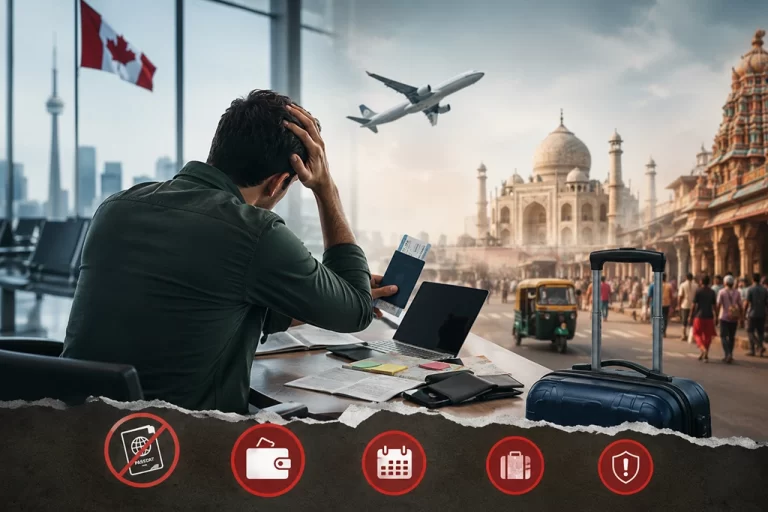
Quick answer: Before booking flights to India from Canada, avoid these 5 mistakes:
(1) missing or expired passport/OCI/visa documents,
(2) booking the cheapest fare without checking layover time,
(3) assuming your domestic connecting flight has the same baggage allowance as your international flight,
(4) exceeding customs duty-free limits on gold and electronics, and
(5) fully cancelling your Canadian SIM before you leave (you’ll need it for banking OTPs). Details, current limits, and a pre-departure checklist are below.
You’ve put in the long shifts, the overtime, the double weekends, and now it’s finally time. You’re going home. Not for a vacation exactly, but for something bigger: hugging your mom at the airport, eating food that actually tastes like home, and showing your family that the move was worth it.
That excitement is real, and you’ve earned every bit of it. But here’s the thing nobody tells you before your first trip back: a few small oversights can turn that homecoming into an expensive, exhausting mess — extra baggage fees, a confiscated gift, or worse, being stopped at check-in over a document you didn’t know you needed.
The good news? Every one of these mistakes is avoidable. Here are the five that trip up new Canadian residents the most, and exactly how to sidestep them.
Mistake 1: Missing a Document in Your Passport, OCI, or Visa Checklist
This is the one that catches people off guard the most, because it feels like it shouldn’t be complicated. You had a passport; you had status what’s changed?
Quite a lot. Once you move to Canada, your travel document situation shifts depending on your status:
- Indian passport holders: Check expiry before booking. Most airlines and Indian immigration require at least 6 months’ validity from your travel date.
- Canadian PR or citizen: You’ll need a valid Indian visa or an OCI (Overseas Citizen of India) card, visa-on-arrival is not available to most travelers of Indian origin.
- New OCI applicants: Processing timelines vary and can run several weeks. Check current OCI processing times and don’t leave the application for the week before departure.
- Name mismatches: If your name changed on any document after immigrating, carry supporting proof (marriage certificate, PR card). Mismatched names are one of the most common reasons for secondary checks at Indian immigration.
Build your document folder for physical and digital copies at least a month before departure, not a week out.
Mistake 2: Choosing the Cheapest Fare Without Checking Total Layover Time
Saving $100–150 feels like a win when you’re already booking an expensive ticket. But that “deal” often comes with two or three layovers stacking up to 15, sometimes 20+, hours of total transit.
The real cost: you land in India jet-lagged, dehydrated, and running on airport food — right before the reunion you’ve been waiting months for.
Smarter ways to compare flights to India from Canada:
- Compare total door-to-door travel time, not just ticket price. A flight that costs $150 more but saves 8 hours of layover time is often the better deal.
- Direct or one-stop routes — via Air Canada, Air India, or carriers like Emirates and Etihad through their Gulf hubs — usually beat budget multi-stop options on total fatigue, even at a slightly higher price.
- Check layover-city transit visa requirements. Some stopover countries require a transit visa depending on your passport, even if you don’t leave the airport.
- Book your seat and meal preference early on long-haul legs. It makes a bigger difference to how you feel on arrival than most people expect.
Mistake 3: Assuming Your Domestic Connecting Flight Has the Same Baggage Allowance
You’ve packed carefully gifts for cousins, snacks, maybe a rice cooker for your mom. Your international carrier allows two 23kg bags, no problem. Then you land in Delhi or Mumbai, connect to a smaller domestic flight to your hometown, and get hit with an excess baggage fee that wipes out whatever you saved on the ticket.
Domestic Indian carriers often allow significantly less than international carriers on the same journey:
Flight Leg | Typical Checked Baggage Allowance |
Canada → India (International, Economy) | 2 bags x 23kg |
India Domestic Connecting Flight (Economy) | 15kg (varies by airline & fare class) |
Excess Baggage Fee (Domestic) | Can run ₹300–600+ per kg |
Allowances vary by airline and fare class — always confirm with your specific carrier before you fly.
If you’re connecting domestically, either pack lighter for that final leg or pre-purchase extra baggage online in advance — it’s almost always cheaper than paying at the counter.
Mistake 4: Not Checking Current Customs Limits on Gold and Electronics
Gifts are part of the tradition — a new phone for your sibling, a laptop for a nephew, gold jewelry for a wedding. But India’s customs rules on duty-free limits are strict, and exceeding them means paying duty on the spot, or in worse cases, having items seized.
Item | Duty-Free Limit (approx.) |
Gold jewelry (Female traveler) | Up to 40g, capped value limit |
Gold jewelry (Male traveler) | Up to 20g, capped value limit |
Electronics (personal use, one each) | Generally allowed duty-free |
Extra laptops/phones (beyond personal use) | Subject to customs duty |
(Limits and thresholds change periodically, always cross-check current figures on the Central Board of Indirect Taxes and Customs (CBIC) site before you fly.)
These are the kind of essential Canada to India flight tips that don’t get talked about enough — because nobody wants their thoughtful gift confiscated over a form they didn’t know they needed to declare.
Mistake 5: Fully Cancelling Your Canadian SIM Card Before You Leave
This one’s sneaky. To save money, you cancel or pause your Canadian phone plan before the trip. Makes sense — until you try to log into your Canadian banking app from India and can’t receive the OTP (one-time password) text needed for two-factor authentication. Now you’re locked out of your own account mid-trip, with no easy fix.
The simple fix: switch to the cheapest pay-as-you-go plan your Canadian carrier offers instead of cancelling outright. Most providers let incoming texts through even on minimal or paused plans to confirm this directly with your carrier before you leave.
Keeping your Canadian SIM active is the difference between a five-minute banking login and a frustrating international support call while you’re supposed to be enjoying family time.
Your Pre-Departure Checklist, By Timeline
Here’s the quick-glance version, grouped by timeline:
Timeframe | What to Check |
1 Month Before | Passport validity, OCI/visa status, book flights (compare layovers, not just price) |
1 Week Before | Confirm baggage allowance per leg, pack gifts within customs limits, arrange SIM pay-as-you-go plan |
Day of Flight | Weigh bags, keep documents + OCI card in carry-on, screenshot boarding passes, charge devices |
This quick-glance India travel checklist is really about protecting the moment you’ve been waiting for, a stress-free reunion back home, not an airport headache before it even starts.
If you’d rather have someone map out the smartest route, baggage combo, and document requirements for your specific situation, that’s exactly the kind of planning Mann Travel handles every day for the Canadian-Indian community. Talk to our team before you book.
FAQs
Do I need an OCI card if I already have Indian citizenship?
No, if you still hold a valid Indian passport, you travel on that. The OCI card applies once you’ve taken Canadian citizenship and given up Indian citizenship.
How far in advance should I book flights to India from Canada?
Generally 2–3 months ahead for the best fare-to-convenience balance, especially around peak seasons like Diwali or summer holidays when demand spikes.
Can I carry both gold jewelry and electronics as gifts without paying duty?
You can carry both, but each has its own separate duty-free limit, going over on either one can trigger duty charges, so check current limits for both categories before packing.
What happens if my domestic connecting flight in India has stricter baggage limits than my international flight?
You’ll be charged excess baggage fees at the counter, calculated per kg, which can add up fast. It’s cheaper to pre-book extra baggage online in advance if you know you’re over the limit.
Is it safe to travel with an expired OCI-linked old passport?
No, if your old Indian passport has expired, its OCI stamp is still valid, but you must carry it along with your new Canadian passport when travelling, not instead of it.